PostJuly 15, 2026
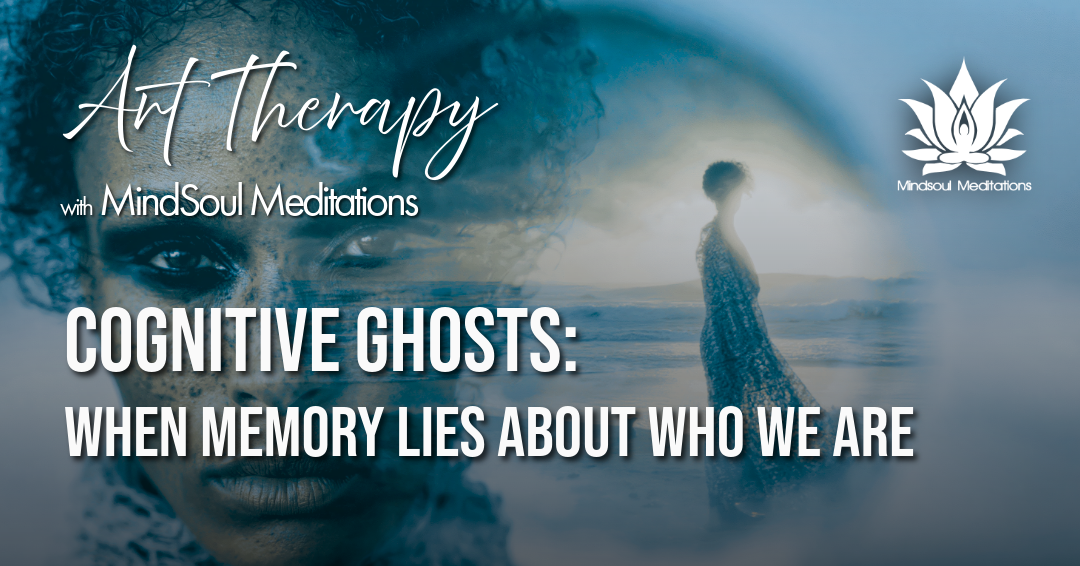
Cognitive Ghosts: When Memory Lies About Who We Are
The outdated self-beliefs that keep occupying rooms in our identity — and an art challenge for making them visible.
There's a particular kind of haunting that doesn't involve creaking floorboards or cold spots in a hallway. It happens quietly, in the space where memory and self-image overlap — when a story we've been carrying about ourselves turns out to be built on a memory that shifted, or a belief that was never fully true to begin with.
I call these cognitive ghosts: the outdated or distorted self-beliefs that keep occupying rooms in our identity long after the 'event' that created them has changed shape, faded, or been misremembered entirely.
What makes a belief a ghost?
Memory isn't a filing cabinet. Every time we recall something, we're reconstructing it — colouring it with our current mood, our current fears, the story we've told about it a hundred times since. A single moment of being embarrassed in third grade can calcify into 'I'm not smart.' One offhand comment from a parent can become 'I'm too much.' The original moment fades, but the belief it left behind keeps operating in the present, making decisions on our behalf.
These beliefs are ghosts because:
- They linger past their expiration date — they were maybe once a protective response to something real, but they've outstayed their usefulness.
- They're half-visible — we sense their influence (the hesitation before speaking up, the reflexive self-deprecation) more clearly than we see the belief itself.
- They repeat — showing up in similar-feeling situations, like a haunting that follows a pattern rather than a place.
Ghosts that were never fully 'ours' to begin with
Not every cognitive ghost comes from a real memory of a real event. Some are stranger than that — they're generated by glitches in perception, or borrowed wholesale from the world around us. These deserve their own attention, because they don't respond to 'just remember what actually happened,' since there was no clean original event to return to.
Déjà vu and presque-vu. Déjà vu — the eerie certainty of having lived a moment before — and its lesser-known cousin presque-vu (the 'on the tip of my tongue' feeling of almost-knowing) are both cases where the brain's familiarity signal fires without an actual matching memory behind it. The feeling of truth arrives before, and independent of, any evidence. That's the exact mechanism of a cognitive ghost: a strong internal sense of 'I know this' or 'this is who I am' that was never actually verified against anything real.
Dreams that outlive sleep. Waking up irritated at a partner because of something they did in a dream is one of the clearest, funniest, and most humbling examples of a cognitive ghost in action. The amygdala doesn't reliably distinguish dreamed emotional content from waking emotional content — so the felt sense of betrayal, grief, or anger is real even though the 'evidence' is not. The dream becomes a false memory the body responds to as though it were fact, colouring an entire day.
Societal tropes and inherited myths. Some of the most persistent cognitive ghosts were never personal experiences at all — they're cultural scripts absorbed so early and so repeatedly that they feel like self-knowledge. 'Good girls don't ask for more,' 'men don't cry,' 'artists can't also be practical,' 'you have to suffer for your work' — these aren't memories, they're myths worn smooth by repetition, and they operate with the same authority as a lived event even though no one ever had to personally verify them. This is collective haunting: a ghost that moved in before you were even old enough to choose your own furniture.
What unites all three of these with the personal-memory ghosts above is the same core mechanism: a feeling of certainty standing in for actual evidence, shaping present-day mood, choices, and self-image regardless of whether anything real is behind it.
Why art is suited to this work
Cognitive ghosts resist direct interrogation. Ask someone 'what false belief do you hold about yourself?' and most people go blank — not because they don't have one, but because the belief operates underneath conscious language. It was formed in feeling and image before it was formed in words.
Art bypasses the part of the brain that wants to explain, defend, or rationalise, and speaks directly to the part that stores the original imprint. When we paint, collage, or shape a cognitive ghost, we often externalise details we didn't consciously know we believed — and once it's outside of us, on paper, it becomes something we can look at rather than look through.
Art Challenge: 'Portrait of a Ghost'
Materials
Any medium you're comfortable with — paint, collage, digital or AI-assisted art, charcoal, or mixed media. Aim for looseness over precision.
The process (3 stages)
Stage 1 — Summon it (10 min). Without overthinking, free-write or free-associate for two minutes on the prompt: 'A time I felt like I wasn't enough / was too much / didn't belong.' Don't edit. Let one memory surface, even if it's small or seems silly.
Stage 2 — Give it a form (25–30 min). Create a visual representation of the belief itself — not the memory, the belief. You might render the ghost as a literal figure (shape, colour, texture), or as an environment, a shadow, or an object. Questions to hold while working:
- What colour is this belief? Is it heavy or light in the image?
- Does it have edges, or does it bleed into everything around it?
- Is there a version of you in the piece — and if so, how much space does the ghost take up compared to you?
Stage 3 — Confront and transform (10–15 min). Add one mark, element, or change to the piece that represents truth, distance, or release — light breaking through, a boundary drawn, a smaller version of the ghost, or a completely separate figure standing apart from it. This step is optional but powerful; leaving the ghost as-is for now is also valid.
Closing prompt. Title the piece. A title often reveals more than you expect.
Variant: 'Borrowed Hauntings'
If you feel more pulled toward the déjà vu / dream / societal myth category than a personal memory, use this alternate entry point in place of Stage 1. Instead of free-writing about a memory, free-write for two minutes on:
- A dream that affected your real-life mood the next day, or
- A 'rule' about who you're supposed to be that you never actually chose — where do you think it came from?
Then move into Stage 2 and 3 as written. The resulting image is often less a portrait of 'me' and more a portrait of an atmosphere or a voice that isn't fully your own — worth naming out loud, at least to yourself.
Share it with the community
This challenge lives beyond the page. To close the loop:
- Join the MindSoul Meditations Community on Webbie Social.
- Post your artwork from the 'Portrait of a Ghost' (or 'Borrowed Hauntings') exercise.
- Tag it #CognitiveGhosts so it's included in the slideshow.
Whether it's a fully worked painting or a quick sketch made in ten minutes between other things, it belongs in this gallery.
Enjoying the program?
Members get workbooks, ebooks, prompt guides, and more — every season.
Join on Patreon